Public websites have a different bar to clear. Citizens don’t choose to visit a tax office or a library portal the way they choose a webshop, so sending their visit data to an ad-tech company is hard to justify. And your legal, procurement and security teams all get a say before anything goes live.
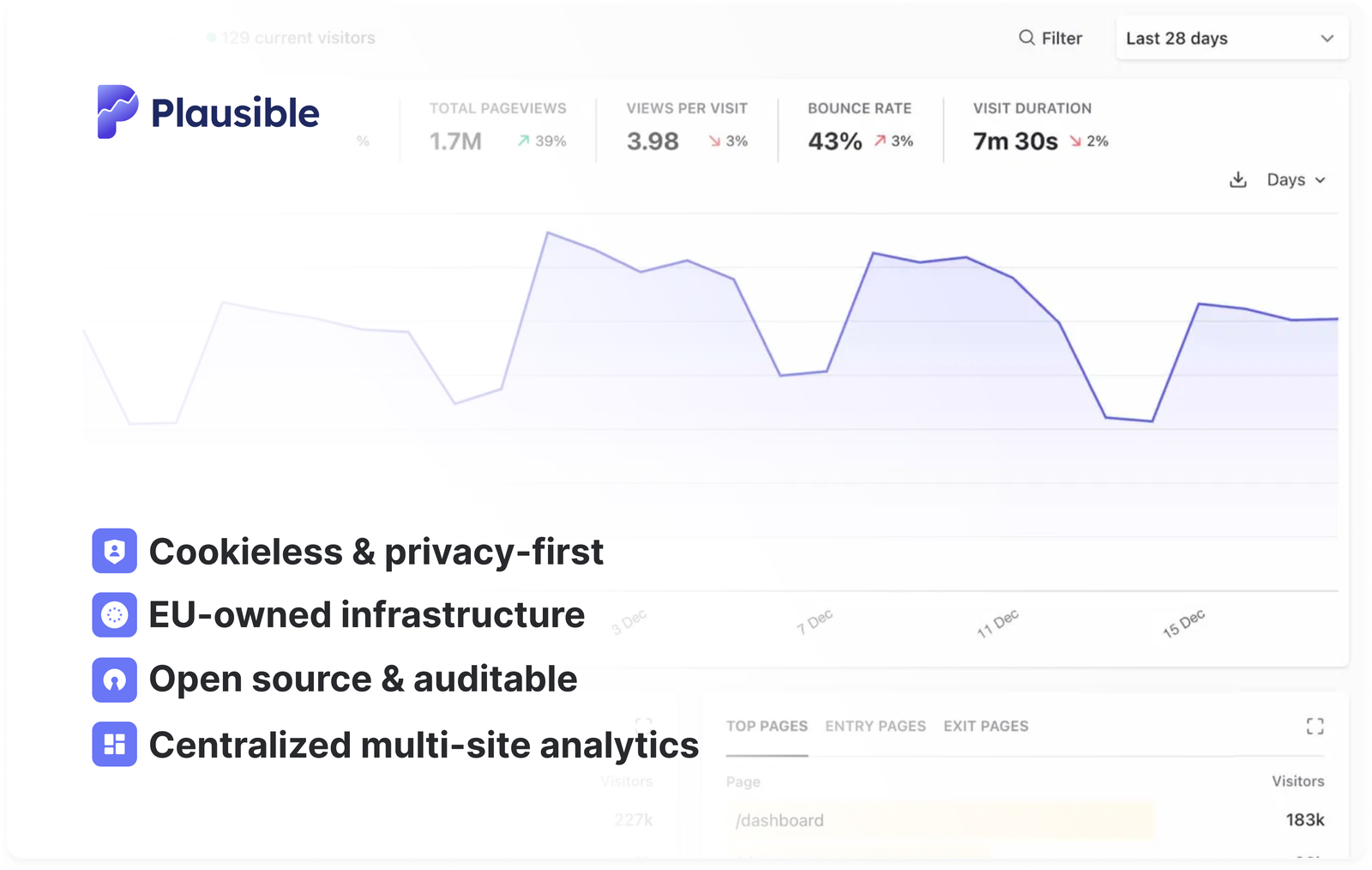
Plausible is built for exactly this situation. No cookies, no personal data collection, no consent banners. All visitor data is processed and stored on EU-owned infrastructure and never leaves the EU. The Scottish and Welsh governments have been running Plausible for years, alongside ministries, municipalities, public libraries and schools across Europe.
This page covers what public-sector reviews usually ask us: where the data lives, what compliance documentation exists and how payment works if a standard card checkout isn’t an option.
- Digital sovereignty, not just GDPR compliance
- No cookies means no consent banner on your public services
- The documentation your compliance review will ask for
- How public-sector purchasing works
- Built for networks of public websites
- Other teams use Plausible for
- Try it before any paperwork
Digital sovereignty, not just GDPR compliance
Many public institutions are moving away from US-owned analytics for two separate reasons. One is legal: cookie-based tools require consent banners, and data transfers to US servers keep coming under regulatory scrutiny. The other is strategic: a growing push across Europe to run public digital infrastructure on European technology.
Plausible answers both. We’re an EU-based company (registered in Estonia, see our imprint) and your visitor data is stored in Falkenstein, Germany, on servers owned by Hetzner, a European company. Not a US hyperscaler’s EU region: EU-owned infrastructure. The difference matters, and we’ve written about why EU-hosted and EU-owned are not the same thing.
Plausible is also open source. Your team can audit the entire codebase, and if your requirements ever demand full infrastructure control, you can self-host the Community Edition on your own servers.
No cookies means no consent banner on your public services
Plausible doesn’t use cookies and doesn’t collect personal data. We count visits in aggregate without building profiles of individual citizens, which means no cookie consent banner is needed for the analytics. An independent legal assessment by a data protection lawyer confirms this approach.
For public services this cuts both ways in your favor: less friction for citizens using your site, and a much shorter privacy review for your DPO.
The documentation your compliance review will ask for
We keep the paperwork public so your review can start before you ever email us:
- Our Data Processing Agreement applies to all subscribers.
- The security and compliance documentation answers the questions typically asked in vendor security reviews, and our security practices are documented in detail.
Because we don’t collect personal data about website visitors or track them as individuals, we’re typically classified as low-risk in vendor assessments. If your questionnaire has items our public documentation doesn’t cover, email us the outstanding questions.
How public-sector purchasing works
All subscriptions are processed by Paddle, our merchant of record. Paddle applies its own sanctions controls and blocks transactions it cannot legally process.
Paddle automatically emails you an invoice after every payment.
If online checkout isn’t an option, add your reseller or procurement partner as a team member with the Billing role. They can manage the subscription and payment while you keep control of the team.
We can provide Paddle’s W-9 form on request. Our company registration, VAT number and legal details are on the imprint page, and Purchasing and vendor information covers the purchasing process.
Built for networks of public websites
Public institutions rarely run one website. A library consortium can have 200 branch sites, a school district one site per school, a ministry a whole family of campaign and service sites.
Plausible handles this from a single account. Standard plans include up to 10 sites. If you need more than 10, Enterprise plans combine a monthly usage tier for the network’s total pageviews and custom events with a site allowance from one of our Enterprise tiers, sized to cover the whole network.
Within your site allowance, adding another site does not change the price or require a plan change. Some of our customers run thousands of sites on one account.
Guest roles let you give each department or branch access to specific sites only. A consolidated view gives leadership one dashboard across the whole network, while shared links let you publish selected dashboards to colleagues or citizens without creating accounts.
For central access control, Enterprise plans support Single Sign-On via SAML 2.0, so your staff log in through your existing identity provider.
Transparency is a natural fit here too. Any dashboard can be made fully public, so citizens can see the same traffic numbers you do. We do this ourselves: our own stats are public.
Other teams use Plausible for
- SaaS products: tracking trial signups, activation funnels and campaign attribution
- Agencies and freelancers: multi-site management, client reporting and GDPR compliance built in
- Content and publishing: tracking what drives traffic, engagement and subscriptions
Try it before any paperwork
You can start a 30-day free trial without a credit card and run Plausible alongside your current analytics. Nothing about your existing setup needs to change during the evaluation.
For a custom plan covering your sites and traffic, email us at hello@plausible.io. We’ll get back to you within one business day.
